

Engineered for Zone 1 and Zone 2 areas, the DCM6-L-IECEx mitigates the risk of high-impact outages caused by battery failures.
FORT COLLINS, Colo. – April 21, 2026 – Parameter, a leading provider of mission-critical infrastructure monitoring systems, today launched the DCM6-L-IECEx, a battery monitoring module purpose‑built for IECEx‑certified operation in Zone 1 and Zone 2 hazardous environments. The DCM6-L-IECEx is natively compliant and eliminates risk at the source, rather than relying on bulky explosion-proof containment – delivering a smaller footprint, easier installation, lower maintenance and proven extended-life protection engineered specifically for the application.
The module enables Parameter's Cellwatch Battery Monitoring and Cellwatch Frontier systems to operate seamlessly in classified zones where explosive gases such as hydrogen are present. The urgency is accelerating across energy sectors. In Bain & Company's 2026 Energy Agenda survey of more than 800 executives, utilities and power generation leaders reported a 60% improvement in their outlook on energy storage's business case over the prior year, making it the second-most-optimistic technology shift in the sector, while oil and gas executives reported a 19% improvement, ranking energy storage among their top five. But energy storage is only as reliable as the batteries behind it – and battery rooms are frequently where critical power failures begin. In the energy sector, they are also among the most dangerous places to send a technician.
From “Enter to Diagnose” to “Enter to Resolve”
In traditional hazardous-area battery management, technicians enter classified zones to take manual readings, diagnose problems and determine next steps. Every entrance event increases personnel exposure to potentially explosive atmospheres.
The DCM6-L-IECEx eliminates that cycle. Continuous cell-level monitoring of voltage, temperature and internal resistance provides predictive failure intelligence, pinpointing which cells are at risk and why, before failures occur. Operators know what is failing and where before anyone enters the room.
Technicians enter only to resolve a confirmed or predicated issue, not to find one. The shift from an “enter to diagnose” workflow to an “enter to resolve” workflow represents a fundamental change in how facilities manage risk in classified environments. This approach substantially reduces entry events, technician risk exposure, and response times.
Built From the Ground Up, Not Bolted Into a Box
Parameter did not simply add an enclosure to an existing product to meet IECEx requirements. The DCM6-L-IECEx was purpose-built for Zone 1 and Zone 2 applications, so the unit itself is intrinsically safe. Certification is engineered into the product, not imposed on it by an enclosure.
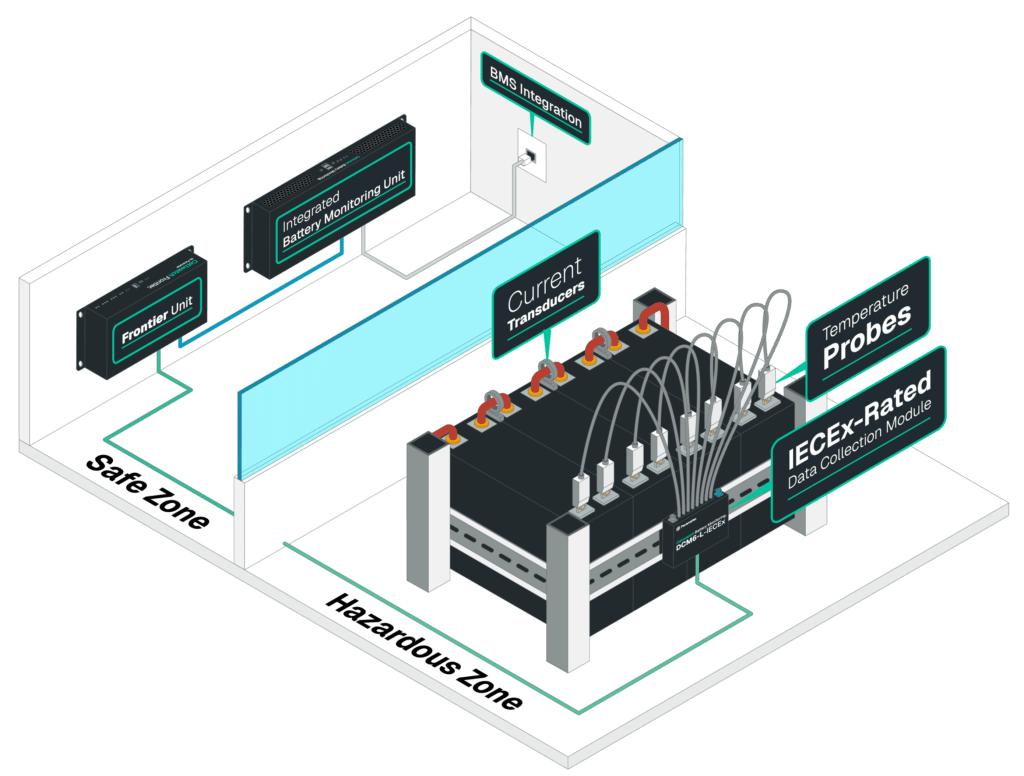
The practical difference is significant. Units mount directly to standard DIN rails without modifying battery room layouts. All leads, terminals and temperature probes ship pre-certified with the module. There are no enclosure gaskets to fail, no additional cable engineering or certification to manage, and no need to remove the unit during battery replacements. Once installed, the system requires zero ongoing maintenance or calibration.
The result is faster installation, a smaller physical footprint, fewer potential points of failure and dramatically fewer entrance events into hazardous zones over the life of the system.
“In hazardous environments, every unnecessary entry is a risk,” said Mike Blazes, CEO at Parameter. “By shifting from ‘enter to diagnose’ to ‘enter to resolve,’ we give operations teams the confidence to act with precision instead of uncertainty. That’s how you protect people, uptime and infrastructure at the same time.”
Converging Risks in the Energy Sector and AI-Scale Data Centers
Two traditionally separate worlds, energy production and digital infrastructure, are now converging around the same operational risks.
Decades of electrification and automation in the oil & gas sector have shifted essential power infrastructure into hazardous environments. Batteries serve as the backbone for shutdown, communications and control functions, often in spaces where explosive gases are present and physical access is tightly constrained.
Mirroring conditions once associated primarily with heavy industry, AI data centers are hurling toward industrial‑scale power architectures. On-site energy storage and generation requires increased battery capacity, resulting in more hydrogen off‑gassing and multiplying the number of classified spaces that require IECEx-certified monitoring solutions.
Regulatory compliance is rising in both sectors, alongside the risks associated with increased power density. The IECEx certification framework has grown from fewer than a dozen member countries to more than 60 approved certification bodies across 35-plus countries, and compliance is becoming a baseline expectation for international operations. The global hazardous-area equipment market is projected to grow from $15.8 billion this year to more than $26 billion by 2034.
“As energy systems and battery infrastructure evolve to meet growing demand, operators are increasingly being asked to manage power environments that are both mission‑critical and hazardous,” said Joe Arena, chief commercial officer at Parameter. “The DCM6-L-IECEx system extends a single, unified monitoring platform across those environments, giving global operators the visibility, compliance and confidence they need to operate safely at scale.”
Key Capabilities
The DCM6-L-IECEx provides continuous cell-level monitoring of voltage, temperature and internal resistance in Zone 1 and Zone 2 classified environments. It carries full IECEx certification for IIC gas groups, the most hazardous classification, covering hydrogen and acetylene. The module integrates natively with Parameter's Cellwatch and Frontier platforms and supports SNMP, BACnet and Modbus protocols for direct connections to building management, SCADA and network management systems. Its enclosure-free, DIN-rail-mount design requires no layout modifications, no post-installation maintenance and no calibration.
Availability
The DCM6-L-IECEx is available now through Parameter's global network of channel partners. Cellwatch is typically purchased as a full solution, with Parameter's team providing materials, installation and training. For technical specifications, contact sales@parameter-tech.com.
About Parameter
Parameter empowers mission-critical infrastructure with a unified monitoring system that identifies disasters before they happen. The company delivers continuous, accurate visibility into leaks, environment and battery health so operators can act before minor threats become major disruptions. Parameter's systems are trusted by data center operators, energy utilities and industrial facilities worldwide. Learn more at parametersystems.com.
Media Contact
Diana Puckett
prforparameter@bospar.com